Turning expertise into measurable energy savings for local authorities
Many local authorities manage an extensive portfolio of buildings, but often have limited capacity to structurally monitor their energy consumption. As a result, simple optimisations are frequently overlooked, even though these so-called “no-regret measures” can deliver fast and measurable energy savings.
Many local authorities manage a large portfolio of buildings, but often have limited time and capacity to structurally monitor their energy consumption. As a result, simple optimisations frequently remain unimplemented. Yet these so-called “no-regret measures” can deliver fast and measurable energy savings.
The “Rollend Capaciteitsfonds”, an initiative of VVSG (Association of Flemish Cities and Municipalities), aims to address this challenge. By deploying expertise for active energy management, local authorities can realise concrete savings that in turn create room for further improvements.
Deploying expertise where it has the greatest impact
Within this project, Factor4 contributed to both phase 1 and phase 2. Expert support was provided to help local authorities identify and implement energy-saving opportunities in their buildings.
The principle behind this approach is deliberately simple: the resources of the fund are not used to finance installations, but rather to provide technical analysis and guidance.
Our role included:
analysing energy consumption in buildings
identifying concrete energy-saving measures
supporting the optimisation of technical installations
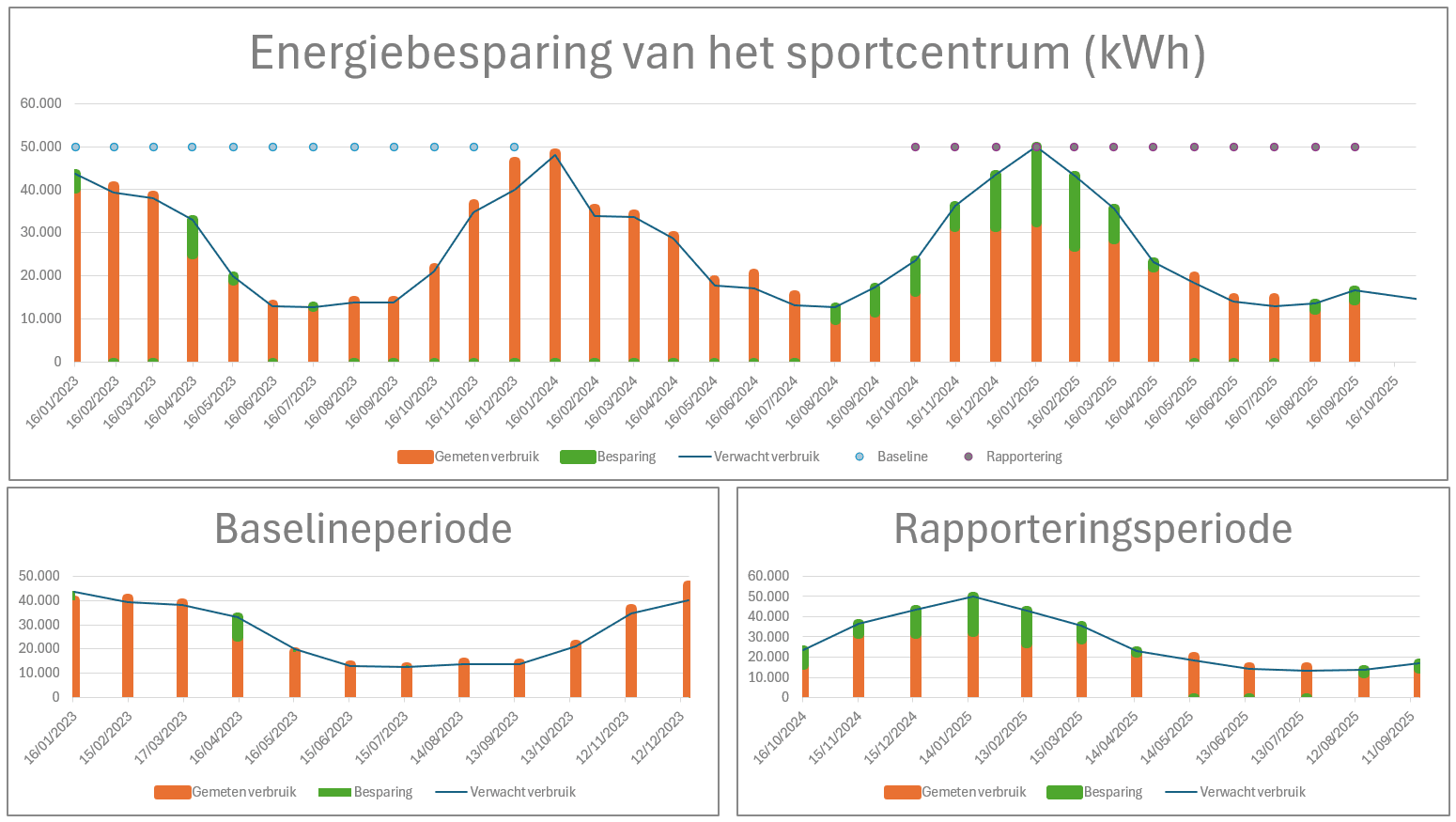
objectively demonstrating the realised energy savings
The focus was often on relatively simple optimisations, such as:
correctly setting heating curves and time schedules
optimising ventilation and heating systems
improving the control and regulation of installations
detecting small technical faults with a significant impact on energy consumption
Although these measures usually require limited investment, they can deliver significant energy savings in the short term.
Objectively demonstrating energy savings
An important part of the project was not only identifying measures, but also objectively demonstrating the realised savings.
For each participating building, energy consumption was analysed before and after the implementation of measures, based on measurement data and technical calculations.
This makes it possible to determine whether the intended energy savings have effectively been achieved.
From pilot project to broader implementation
During phase 1, the concept of the “rollend capaciteitsfonds” was tested with several local authorities. The positive results confirmed that targeted expertise in energy management can quickly create value.
In phase 2, the project was scaled up through collaboration with intermunicipal organisations, allowing the methodology to be applied across a larger group of municipalities.
This project demonstrates that existing buildings often contain considerable energy-saving potential, even without major investments. The key is to correctly identify the right measures from a technical perspective, implement them carefully, and objectively monitor and demonstrate the results afterwards.
Working together towards structural energy management
Factor4 looks back with great satisfaction on the collaboration within this project and would like to thank VVSG, the participating local authorities and the intermunicipal organisations for their trust and constructive cooperation.
Local authorities that wish to further develop active energy management can still rely on this expertise today. In coordination with the Flemish Energy Company (VEB), Factor4 is part of the consultancy offering for energy efficiency and control optimisation. This enables municipalities to continue receiving technical support to identify, implement and objectively monitor energy savings in their buildings.
Recent articles

IPMVP Training – Measurement & Verification (M&V) by Sven Wuyts
Factor4 is organizing a practical training on IPMVP – Measurement & Verification (M&V), the international standard for accurately measuring and proving energy savings. Click for more information.

Province of West Flanders decarbonises six sites through innovative energy performance contract
The Province of West Flanders is taking an important step in the decarbonisation of its building portfolio.

Strategic real estate plan for Laakdal approved by municipal council
Factor4 supported Laakdal in the development of the strategic real estate plan. The objective: to structurally align municipal real estate with the public services provided by the local authority, both today and towards 2050.