Province of West Flanders decarbonises six sites through innovative energy performance contract

The Province of West Flanders is taking an important step in the decarbonisation of its building portfolio.
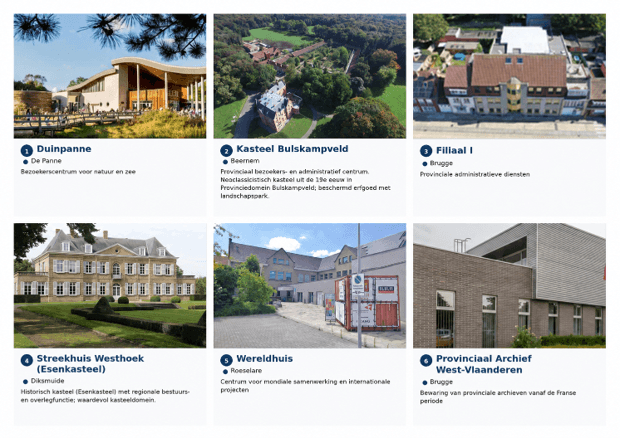
The Province of West Flanders is taking an important step in the decarbonisation of its building portfolio. An innovative energy performance contract has been awarded for six provincial sites. This approach not only guarantees energy savings, but also focuses on high-quality maintenance and the long-term residual value of the installed systems.
For the preparation and procurement of this project, the Province of West Flanders relied on Factor4. Using our Building Performance Contract (BPC) methodology, we guided the entire process, from the analysis of the buildings to the preparation of the tender documents.
An energy performance contract that goes beyond energy savings
Traditional energy performance contracts mainly focus on guaranteed energy savings over the contract period. The Factor4 BPC methodology takes this a step further.
In addition to energy savings, maintenance, technical performance, and the residual value of the systems are contractually defined. This ensures that investments are not limited to measures with short payback times, but also include sustainable solutions that create long-term value.
During the preparation phase, all relevant technical and operational data of the sites were collected and analysed. Following this thorough assessment and a market consultation, the consortium Wattson and Demtec Services was selected as the successful ESCO. The contract will commence on 1 August 2026 and will run for a period of ten years.
A contract that rewards quality
Under the contract, the ESCO is responsible not only for the implementation of energy-saving measures, but also for the maintenance, optimisation, monitoring, and reporting of the installed systems.
A key feature of this project is that the ESCO also guarantees a minimum residual value of the installations at the end of the contract period. To meet this commitment, the systems must be properly maintained throughout the entire duration of the contract.
As a result, the consortium guarantees that all installed systems, such as heat pumps, solar panels, and roofing elements, will achieve a higher end-of-contract condition score than is typically targeted in conventional maintenance contracts.
This approach creates a clear win-win situation. The ESCO invests in sustainable solutions with longer payback periods and has a strong incentive to keep all systems in excellent condition for the full ten-year duration of the contract.
Managing uncertainties in a smart way
During the preparation of the contract, several key boundary conditions were still uncertain.
For example, it was not yet clear whether the electricity grid at all locations would have sufficient capacity to support heat pump installations. It also needed to be assessed whether the existing heating systems were suitable for low-temperature operation.
Nevertheless, ESCO bidders were required to submit a fixed price and guaranteed energy savings.
Thanks to the flexible contract structure of the Building Performance Contract methodology, these uncertainties could be properly addressed. The structure ensured a balanced allocation of risks and made uncertainties manageable, allowing bidders to submit competitive offers without being exposed to factors beyond their control.
Tangible results across six provincial sites
The selected measures will significantly improve the sustainability of the buildings involved.
Several sites will be fully or largely disconnected from natural gas, through the installation of heat pumps or connection to a district heating network.
In addition, photovoltaic panels with a total peak capacity of 370 kWp will be installed across all sites.
Energy-efficient lighting and additional insulation measures are also part of the project, taking into account the specific context of each location.
A benchmark for the public sector
With this project, the Province of West Flanders demonstrates how public buildings can be decarbonised in a future-oriented way.
It illustrates how an integrated approach combining energy savings, maintenance, and long-term performance can support public organisations in making their building portfolios more sustainable.
Recent articles

IPMVP Training – Measurement & Verification (M&V) by Sven Wuyts
Factor4 is organizing a practical training on IPMVP – Measurement & Verification (M&V), the international standard for accurately measuring and proving energy savings. Click for more information.
Province of West Flanders decarbonises six sites through innovative energy performance contract
The Province of West Flanders is taking an important step in the decarbonisation of its building portfolio.

Strategic real estate plan for Laakdal approved by municipal council
Factor4 supported Laakdal in the development of the strategic real estate plan. The objective: to structurally align municipal real estate with the public services provided by the local authority, both today and towards 2050.