Is your building ready for a sustainable heating solution? Take the 50 degree test!

Wondering if your building is ready for a sustainable heating solution? With the 50 degrees test you can easily gain insight into the energy performance of your building. By reducing the supply temperature of your heating system, you can find out whether your building is suitable for low-temperature heating and how you can take steps towards a fossil-free future.
The 50 degrees test makes it easy to find out whether your building is suitable for a switch to sustainable heating solutions, such as a heat pump. It is a practical way to gain insight into your building's energy performance, without the need for large investments.
Many people think that sustainable heating is only possible in perfectly insulated buildings with underfloor heating, but this is not always true. Even traditional systems can often work surprisingly well with low-temperature heating. By reducing the supply temperature of your heating system, you can find out whether your building is ready for a sustainable future.
How does the 50 degree test work?
1. Set the temperature to 50 degrees.
Set the flow temperature of your boiler to 50 degrees. Make sure you only lower the temperature of your heating water, not your domestic hot water.
2. Observe during a cold spell.
Check whether the building remains comfortably warm even at outdoor temperatures of -5°C or lower.
3. Draw conclusions.
Did the building stay comfortably warm? Then it is suitable for low-temperature heating and potentially for a heat pump.
Is it not getting warm enough? Then you can make targeted improvements, such as better insulation or more efficient heating systems.
4. Make a plan.
Factor4 will help you with concrete advice, from insulation measures to choosing sustainable heating systems.
What are the benefits of the 50 degree test?
Direct energy savings: Boilers operating at 50 degrees use less energy than when set to 80 degrees.
Future-proof: The test shows whether you are ready for a heat pump or hybrid system.
Insight into areas for improvement: You discover what adjustments are needed to get your building ready for the 2050 climate goals.
This test is not only useful for homes, but also for offices, schools and other non-residential buildings. Factor4 can assist in developing a strategy to make your property more energy efficient and meet the climate goals.
Ready to take the 50-degree test?
Recent articles

IPMVP Training – Measurement & Verification (M&V) by Sven Wuyts
Factor4 is organizing a practical training on IPMVP – Measurement & Verification (M&V), the international standard for accurately measuring and proving energy savings. Click for more information.

Province of West Flanders decarbonises six sites through innovative energy performance contract
The Province of West Flanders is taking an important step in the decarbonisation of its building portfolio.
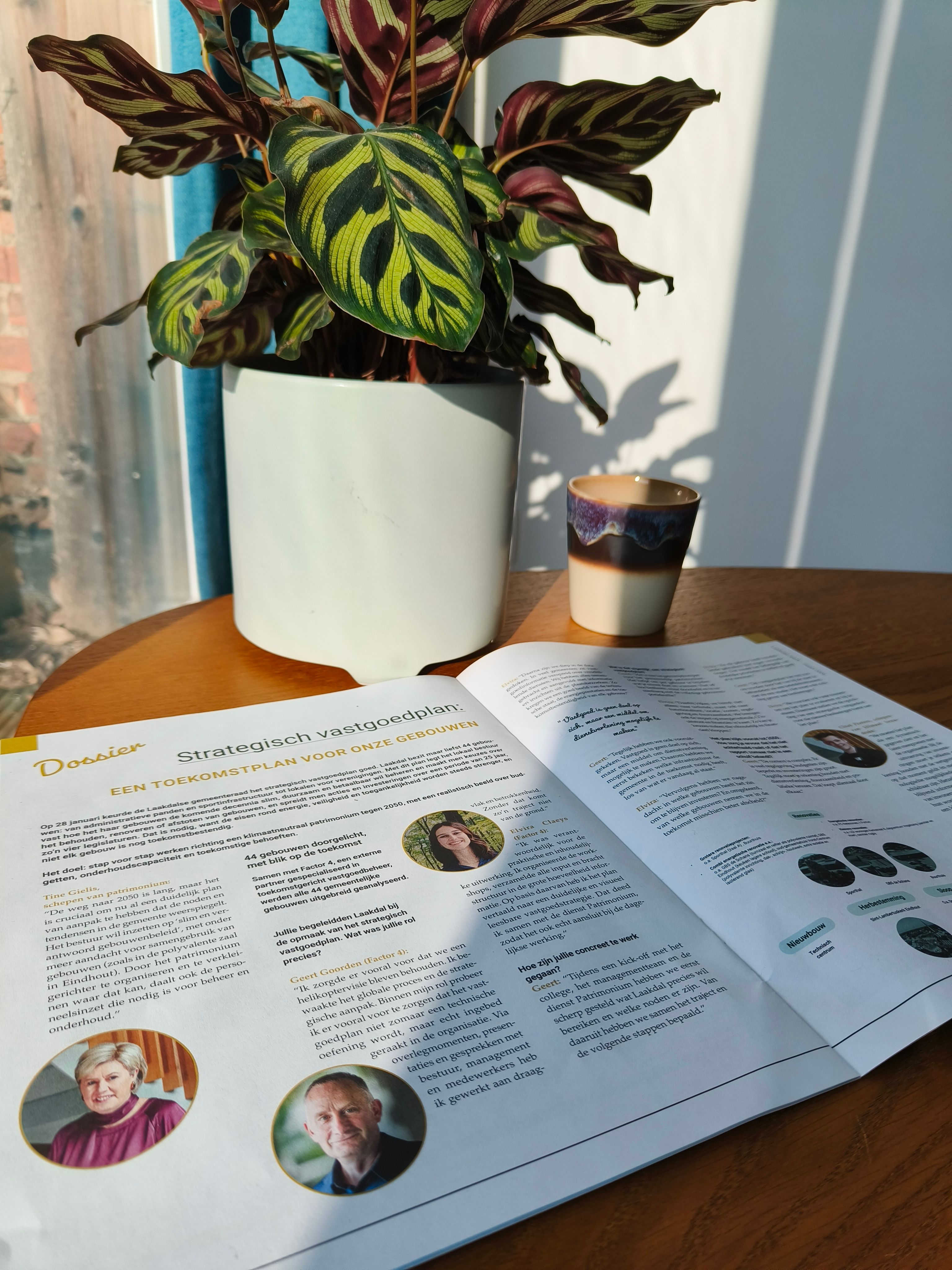
Strategic real estate plan for Laakdal approved by municipal council
Factor4 supported Laakdal in the development of the strategic real estate plan. The objective: to structurally align municipal real estate with the public services provided by the local authority, both today and towards 2050.